



What Is Cold Lamination?
Cold lamination is a process used to protect and enhance the surface of a wide variety of materials without the use of high temperatures. Instead of heat-activated adhesive, it employs pressure-sensitive adhesive films that bond permanently to the substrate under roller pressure.
This technology is primarily used for materials that could be damaged, distorted or otherwise affected by the temperatures required for thermal lamination.
Despite its name, cold lamination does not always mean that no heat is involved. Some laminators are equipped with heated rollers that can gently warm the material to approximately 40–60°C (105–140°F). Unlike thermal lamination, this low temperature does not activate the adhesive; instead, it improves adhesive flow and bonding, resulting in better adhesion and a more consistent finish. By comparison, thermal laminating films are typically processed at temperatures of around 90–115°C (195–240°F), depending on the film manufacturer’s recommendations.
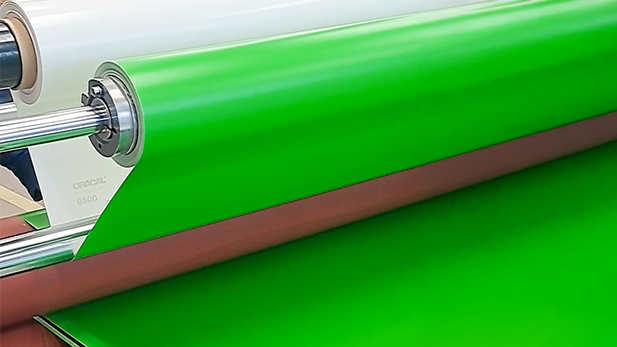
When Is Cold Lamination Used?
Cold lamination is the preferred solution whenever the material should not be exposed to high temperatures or when pressure-sensitive films are required.
Typical applications include:
- wide-format graphics,
- self-adhesive films,
- advertising and display boards,
- POS and POP display systems,
- photographs,
- temperature-sensitive printed materials,
- plastic sheets and other rigid substrates requiring protection or surface enhancement.
Cold lamination is also widely used to protect graphics against UV exposure, moisture, dirt and mechanical damage.
Cold Lamination vs Thermal Lamination
Both cold and thermal lamination are designed to protect and enhance printed materials, but they rely on different bonding methods.
Thermal lamination uses films coated with heat-activated adhesive, while cold lamination employs pressure-sensitive adhesive films that require only controlled roller pressure to achieve a permanent bond.
The choice between the two technologies is determined primarily by the substrate, the type of film being used and the intended application rather than personal preference.
How Does the Process Work?
During the laminating process, the substrate and the film pass through a pair of laminating rollers that apply uniform pressure across the entire working width. This pressure activates the bonding process between the pressure-sensitive adhesive and the material.
The quality of the finished product depends on several factors, including correct roller pressure, accurate material handling, proper film selection and the quality of the substrate itself.
Laminating Materials of Different Thicknesses
One of the key features that distinguishes cold laminators from many conventional sheet laminators is the ability to adjust the roller gap.
Cold laminators can process materials ranging from thin flexible films to thick rigid plastic boards. The roller gap can therefore be adjusted to match the thickness of the substrate and, depending on the machine design, may be increased to several or even several tens of millimetres.
Accurate gap adjustment ensures consistent pressure across the material, which is essential for achieving high-quality lamination results.
More Than Protective Lamination
Cold laminators are used for far more than applying protective films.
The same technology is widely used for applying self-adhesive materials such as application tapes, transfer films and adhesive films used in the production of advertising graphics and display systems.
In these applications, the machine acts as an applicator, providing even pressure across the entire width of the material while ensuring accurate, bubble-free application.
Advantages of Cold Lamination
The main advantages of cold lamination include:
- suitable for heat-sensitive materials,
- eliminates the risk of heat-related distortion,
- excellent protection against moisture and contamination,
- improved UV resistance,
- accommodates materials of widely varying thicknesses,
- suitable for applying pressure-sensitive films and other self-adhesive materials.
Limitations
Cold lamination is not intended to replace thermal lamination.
For many standard sheet-fed printing applications, thermal lamination remains the more economical solution and offers a wider selection of decorative and speciality films.
The choice of technology should therefore always be based on the material being processed, the required finish and the specific application.
Expert Insight
Cold lamination and thermal lamination are complementary technologies rather than competing ones. The appropriate process is determined primarily by the characteristics of the substrate and the type of film being used. Modern cold laminators are increasingly equipped with gently heated rollers that improve adhesion while preserving all the advantages of pressure-sensitive lamination.
Cold Laminating Equipment
Cold laminators are widely used in commercial printing, sign making and display production.
Depending on the application, machines may include features such as gently heated rollers, precision material guidance systems and adjustable roller gaps, enabling efficient processing of both flexible and rigid materials.
Selecting the right configuration depends on the substrate, production volume and the intended application.
Need Advice?
If you are considering cold lamination or need help selecting the right laminating equipment and materials, our specialists will help you choose the solution best suited to your production requirements.
Related Articles
- Laminating Films – Types, Properties and Selection
- Encapsulation – Complete Sealing of Printed Materials
- Digital Foiling – Process, Benefits and Applications