


The Flying Knife Separator was developed to overcome the limitations of conventional Burst Separation. By mechanically cutting the laminating film rather than tearing it, it enables the automatic separation of sheets laminated with films that cannot be reliably separated using the Burst method. This article explains how a Flying Knife Separator works, why different laminating films require different separation methods, and why the DUO System provides the most versatile solution for modern sheet-fed laminators.
Why Is Sheet Separation Necessary?
After lamination, individual sheets leave the laminating section connected by a continuous web of laminating film. Before they can be transferred to the next production stage, they must be separated into individual sheets.
The separation method depends primarily on the type of laminating film and the separator fitted to the laminator.
The most common solution is the Burst Separator. It is a relatively simple and highly efficient system that remains the preferred choice for most standard laminating applications.
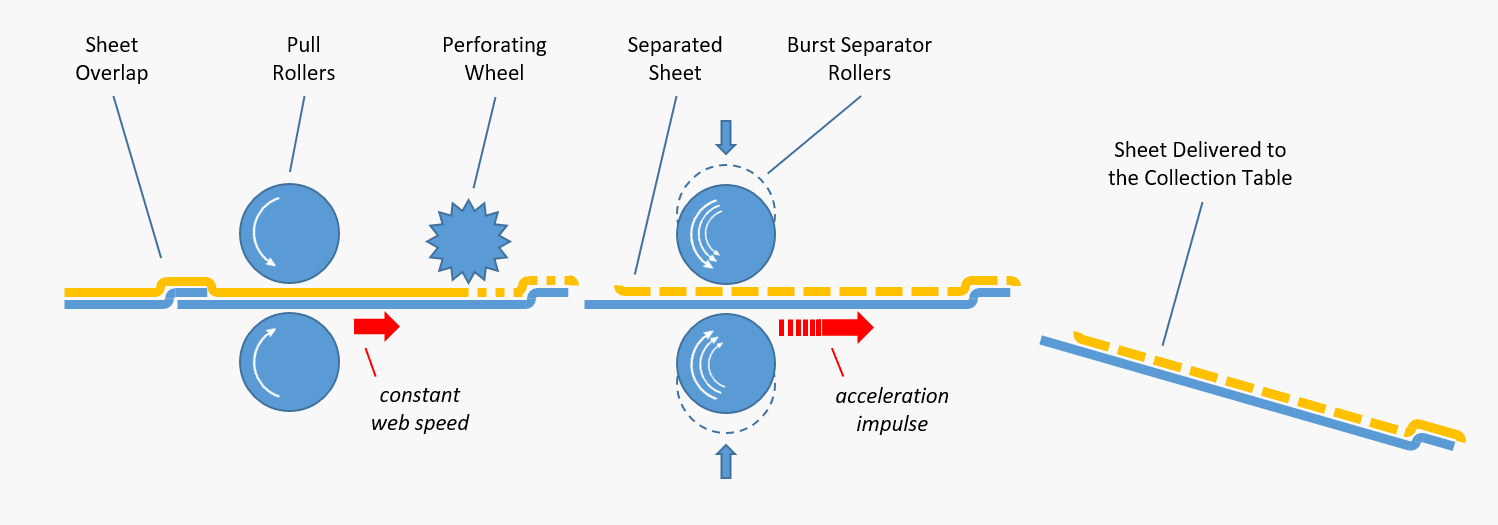
Burst Separator Operating Principle
Why Isn't a Burst Separator Always Sufficient?
A Burst Separator takes advantage of the properties of Burst laminating films, allowing the film to split cleanly between consecutive sheets. These are typically OPP/BOPP films that undergo monoaxial or biaxial orientation during manufacturing. This process aligns the molecular structure of the material, giving it predictable tear characteristics in a specific direction. When the correct separating force is applied, the film breaks along a clean, straight line.
This method is extremely fast and reliable, but only when the laminating film has the appropriate mechanical properties.
As the range of laminating films expanded, the industry increasingly adopted materials that cannot be separated by controlled tearing.
These include, among others:
- nylon (OPA) films,
- certain PET films,
- metallised films,
- thicker speciality laminating films,
other films with high tear resistance.
Why Can Some Films Be Torn While Others Must Be Cut?
The performance of a Burst Separator depends far more on the mechanical properties of the laminating film than on the separator itself.
OPP/BOPP films are specifically engineered to produce a controlled tear during separation. This allows clean, repeatable sheet separation even at very high production speeds.
Nylon (OPA) films behave very differently. They offer significantly higher tensile strength and tear resistance. Instead of producing a clean tear, the material tends to stretch and deform, making reliable separation by a Burst Separator difficult or, in some cases, impossible.
PET films occupy an intermediate position. They are stiffer than OPP films while also providing greater tear resistance. Depending on film thickness, orientation and construction, some PET films can be separated using the Burst method, whereas others require mechanical cutting with a Flying Knife Separator.
These differences in the mechanical behaviour of laminating films were the primary reason for the development of Flying Knife separation technology.
How Does a Flying Knife Separator Work?
Unlike a Burst Separator, a Flying Knife Separator does not tear the laminating film.
Instead, it separates consecutive sheets by mechanically cutting the film.
Although several Flying Knife designs are used, their operating principle remains the same. A cutting blade is synchronised with the moving sheet stream and cuts the laminating film precisely within the overlap between consecutive sheets. Individual machine designs may differ in blade geometry or drive systems, but the objective is always identical: accurate, repeatable separation without damaging the laminated sheets.
Modern ZFP laminators use a single-blade Flying Knife system driven by a servo motor and controlled by an opto-electronic registration system. Once the overlap between two consecutive sheets is detected, the control system calculates the exact moment at which the blade enters the overlap.
The blade then travels across the web while simultaneously moving with the sheet stream. Its diagonal path, combined with synchronised motion, produces a cut that is perfectly square to the sheet edge despite the continuous movement of the laminated web.
After completing the cut, the blade automatically returns to its home position, ready for the next cutting cycle.
Although mechanically simple in principle, this solution combines precision servo control with accurate registration, ensuring highly repeatable separation even at high production speeds.
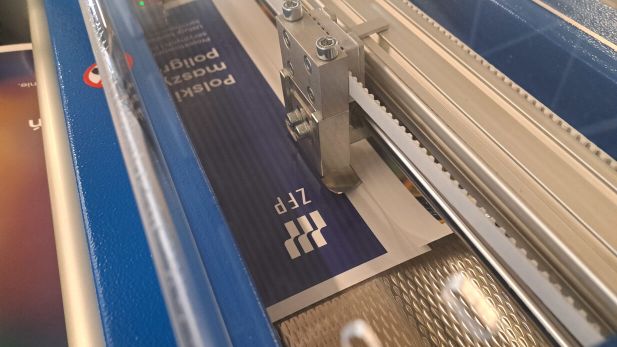
Flying Knife Separator in Neptune FK
Advantages of Flying Knife Technology
The greatest advantage of a Flying Knife Separator is its ability to separate laminating films that cannot be processed using the Burst method.
This significantly expands the range of laminating films that can be used without sacrificing production automation.
Another important benefit is the quality of separation itself. Since the film is cut rather than torn, the process eliminates irregularities that may occur during tearing and which can interfere with subsequent production stages.
This becomes particularly important when laminated sheets undergo further finishing operations such as additional printing, varnishing or a second laminating process. Excess film left after tearing may increase the risk of marking, snagging or sheets sticking together, whereas a clean cut provides a more controlled result.
Limitations of Flying Knife Technology
Like any separation technology, Flying Knife systems also have practical limitations.
The most significant is the time required to complete one cutting cycle.
Cycle time depends primarily on the cutting distance, which corresponds to the sheet width, while sheet length determines the available return time before the next cut must begin.
As a result, the maximum operating speed is determined by the combination of web speed, sheet width and sheet length.
Another important limitation concerns double-sided lamination.
A conventional Flying Knife Separator relies on access to the sheet overlap from one side of the laminated web. Once both sides of the sheet have been laminated, this overlap is effectively enclosed between two films, preventing the blade from entering the separation point.
For this reason, ZFP primarily applies Flying Knife technology to laminators designed for small and medium sheet formats, such as the D&K Neptune FK and D&K Europa FK. For larger, faster machines, where cutting frequency could become the limiting factor, the optimum solution is the DUO Separation System.
Flying Knife or Burst Separation?
Flying Knife and Burst Separation are not competing technologies. Each has been developed to meet different production requirements and to process different types of laminating films.
A Burst Separator delivers maximum productivity when working with Burst laminating films specifically designed for controlled tearing. Its simple operating principle enables extremely high production speeds with minimal mechanical complexity.
A Flying Knife Separator, on the other hand, considerably expands the range of films that can be processed automatically. By mechanically cutting the laminating film rather than tearing it, it enables reliable separation of high tear-strength materials such as nylon (OPA), selected PET films and other speciality laminating films.
The choice between the two technologies therefore depends not on which system is "better", but on the laminating films being used and the production requirements.
Why Was the DUO System Developed?
In practice, many print finishers regularly process both Burst laminating films and films that require mechanical cutting. Purchasing separate laminators for different film types would be both expensive and inefficient.
To solve this challenge, ZFP developed the DUO Separation System, combining a Burst Separator and a Flying Knife Separator within a single laminator.
Both separation systems remain permanently installed in the production line, allowing the laminated web to pass through both units simultaneously. The operator simply selects the appropriate separation method for the current job without changing the web path or reconfiguring the machine.
Unlike many hybrid solutions that compromise the performance of individual technologies, the DUO System integrates two fully functional and independent separation systems. Each operates exactly as it would in a dedicated machine, allowing the operator to benefit from the full performance of both technologies whenever required.
As a result, Burst laminating films can be processed at maximum productivity, while speciality films can be separated using the Flying Knife system—all on the same laminator.
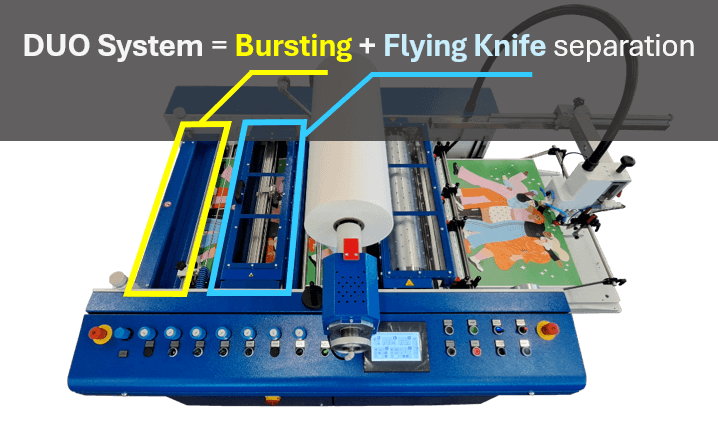
DUO Separation System in the D&K Jupiter Landscape Laminator
Summary
Flying Knife and Burst technologies are not alternatives competing for the same application. Each has been developed to meet different material characteristics and production requirements.
Rather than creating a compromise between these two methods, ZFP developed the DUO Separation System, integrating two independent, fully functional separation technologies into a single laminator. This allows operators to benefit from both maximum productivity and maximum processing flexibility without sacrificing the performance of either system.
Related Articles
- DUO Separation System – Combining Two Separation Technologies
- Burst Separator – Operating Principle and Applications
- Nylon Laminating Films (coming soon)
- How to Choose the Right Laminating Film (coming soon)