



Burst separation has remained the primary method of separating laminated sheets for many years. Despite the emergence of newer technologies such as the Flying Knife, it still delivers the highest productivity and remains the preferred solution for the vast majority of standard laminating films.
Why does burst separation continue to perform so well in most applications? How does the process work, and what are its limitations? This article explains the operating principle of the Burst Separator and shows when it is the best choice and when other separation technologies should be considered.
Why Is a Separator Needed?
After lamination, consecutive sheets remain connected by a continuous web of laminating film. Before they can proceed to subsequent production stages such as die-cutting, varnishing, folding or binding, they must be separated back into individual sheets.
The most widely used solution is the Burst Separator. Simple, reliable and capable of operating at very high production speeds, it has been the industry standard in sheet-fed laminators for decades.
How Does a Burst Separator Work?
A Burst Separator uses short acceleration impulses applied to the section of laminated web passing through the separator, creating a local increase in film tension. When the separator rollers, rotating at a higher speed than the pull rollers, close on the outgoing sheet, they rapidly accelerate it, increasing the tension between the sheet being pulled by the separator and the following sheet, which is still held by the pull rollers. Thanks to the previously perforated overlap, the film tears between the last two sheets, releasing the separated sheet.
Different laminator designs use different types of Burst Separators. Besides conventional bursting rollers, some systems employ a skew wheel, which initiates separation by changing the direction of the separated sheet and deflecting it away from the axis of the laminated web. Regardless of the mechanical design, the operating principle remains the same – controlled use of film tension to separate consecutive sheets.
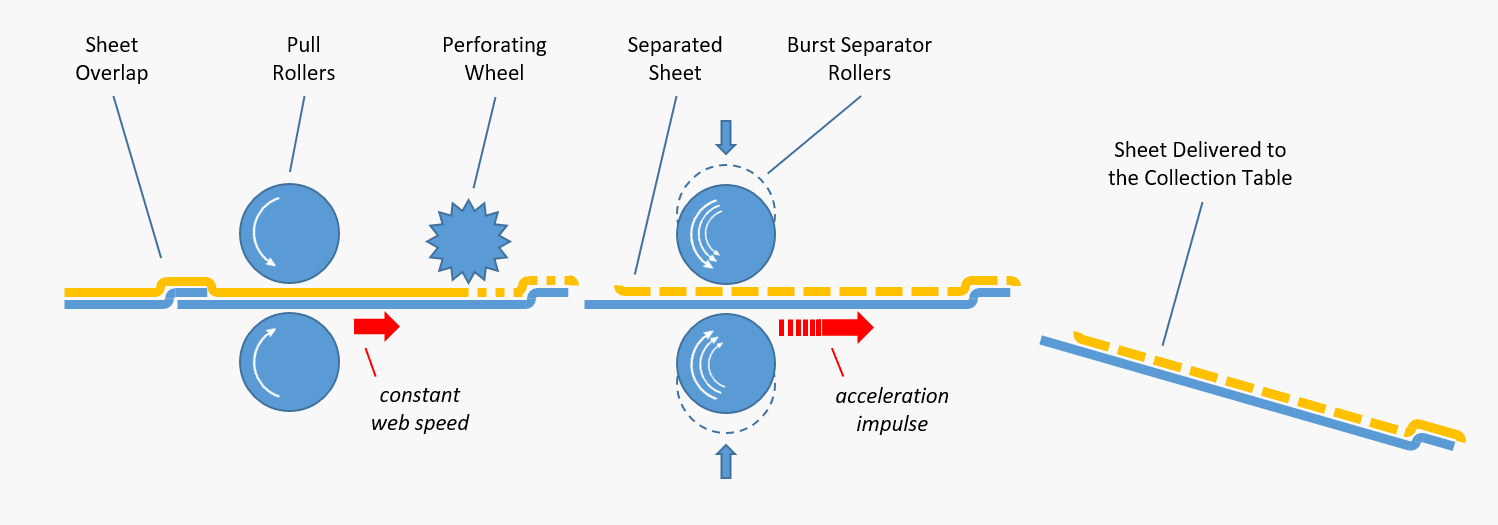
Burst Separator Operating Principle
Why Does the Film Tear?
The effectiveness of burst separation depends on the mechanical properties of the laminating film. Most standard BOPP films offer high strength during normal use, yet once perforated they will tear in a controlled manner along the weakened line. Under the momentary increase in tension, the tear starts at the perforated edge and propagates across the overlap between consecutive sheets.
Not all laminating films behave this way. Materials with high tear resistance, such as nylon (OPA) and some PET films, do not tear reliably even after perforation. In these applications, alternative separation methods based on cutting rather than tearing are required.
Advantages of Burst Separation
Despite the availability of alternative separation technologies, the Burst Separator remains the standard solution in most sheet-fed laminators. Its popularity results from the combination of high productivity, mechanical simplicity and compatibility with the majority of commercially available laminating films.
The main advantages of burst separation include:
- operation at very high laminating speeds,
- excellent separation performance with most standard BOPP films,
- compatibility with economical laminating films designed for burst separation,
- simple, durable construction with low maintenance requirements,
reliable operation even during long production runs.
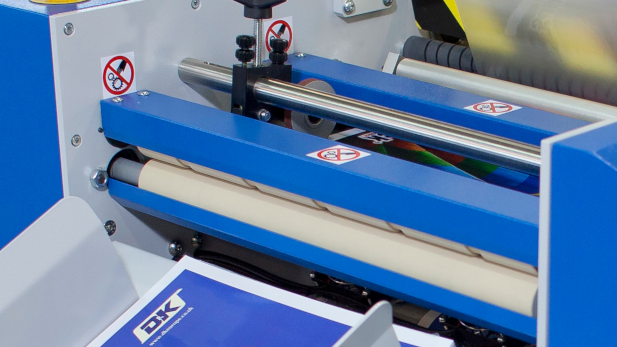
Burst Separator in Neptune B3 Laminator
Limitations of Burst Separation
The performance of a Burst Separator depends on the mechanical properties of the laminating film. It is most effective with films that can be predictably torn along the perforated overlap between consecutive sheets.
With highly tear-resistant materials such as nylon (OPA) and certain PET films, consistent separation becomes difficult or impossible. In such cases, alternative technologies are used, primarily cutting separators such as the Flying Knife, as well as hot knife and guillotine cutting systems.
When Is a Burst Separator the Best Choice?
A Burst Separator is the optimum solution wherever standard laminating films intended for perforation and burst separation are used. Thanks to its high productivity, simple construction and proven reliability, it remains the most widely used separation method in industrial sheet-fed laminators.
For most applications there is no need to replace burst separation with another technology. Only highly tear-resistant films or specific production requirements justify the use of cutting separators, such as the Flying Knife.
Summary
Burst separation has remained the primary method of sheet separation after lamination for many years. Its popularity is based on high productivity, mechanical simplicity and compatibility with the majority of standard laminating films.
The growing use of materials such as nylon (OPA) and selected PET films has driven the development of alternative separation technologies. Modern laminators continue to refine solutions dedicated to different film types, while the most advanced machines can combine multiple separation technologies in a single system (the DUO System), allowing the operator to select the most appropriate method for the current production job.
Related Articles
- Flying Knife Separator – How It Works, Benefits and Applications
- DUO System – Two Separation Technologies in One Machine
- Nylon (OPA) Laminating Films
- How to Choose the Right Laminating Film