


A Flying Knife separator enables automatic separation of sheets laminated with films that cannot be effectively separated using the Burst method. Instead of bursting the film between consecutive sheets, the separator cuts it mechanically. Most importantly, sheet separation takes place without stopping the laminated web.
This technology extends the range of materials that can be processed on automatic laminators, particularly films with high tear resistance.
Why is a separator needed?
During lamination, consecutive overlapped sheets form a continuous web in which the sheets are connected by the laminating film. To obtain individual sheets ready for further processing, they must be separated again.
The most commonly used solution is a Burst Separator. This method is very fast and works particularly well with OPP/BOPP films suitable for controlled Burst Separation.
However, not all materials have the properties required for reliable bursting. OPA nylon films, PET films, metallized films and some thicker specialty films have significantly higher tear resistance. In such cases, the film must be cut rather than burst.
More information about the properties of different materials can be found in the article Laminating Films.
How does a Flying Knife separator work?
Unlike a Burst Separator, a Flying Knife does not burst the film, but cuts it between consecutive sheets.
Current ZFP laminators use a system with a single knife driven by a servo motor. Once the overlap between two sheets is detected, the knife is activated at the appropriate moment and cuts the film across the moving web.
The angled cutting edge of the blade, combined with synchronization of its speed with the movement of the material, makes it possible to obtain a cutting line perpendicular to the edge of the sheet. The knife moves perpendicular to the web direction and, thanks to the symmetrical shape of the blade itself, can cut in both directions, doubling the separator's productivity.
ZFP uses this technology, among others, in the L100 FK B3 laminator and the L200 FK B2 laminator, designed for applications requiring films that are difficult or impossible to separate reliably by Burst technology.
In practice, Flying Knife technology can be used to cut virtually any laminating film. The machine easily cuts both difficult-to-burst films and those that are non-burstable, such as polyester or nylon. For this reason, FK-series models can be regarded as universal laminators.
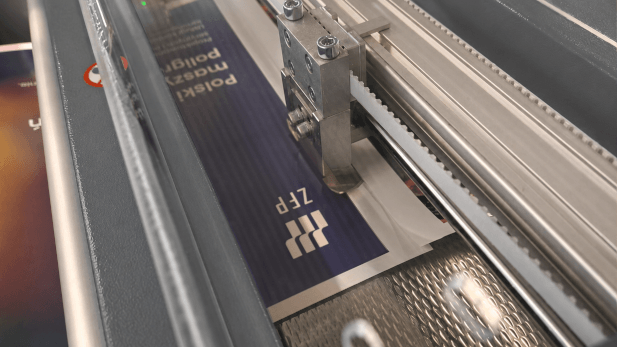
Flying Knife Separator in the L100 FK
Advantages of Flying Knife technology
The main advantage of a Flying Knife separator is its ability to automatically separate materials that cannot be processed reliably using the Burst method. The user is therefore not limited to films suitable for Burst Separation.
Mechanical cutting also provides a consistent separation line and helps avoid the excessive film fringe that may sometimes remain after bursting. This is particularly important when laminated sheets are to undergo further printing or finishing processes.
Limitations of Flying Knife technology
Despite the high speed of the knife, separator productivity depends primarily on the width of the web and the speed of material transport, as well as on the distance between consecutive overlaps. The knife must complete a full traverse across the material width before the overlap in the web moves beyond the knife's reach.
The ability to cut in both directions eliminates an idle return stroke and significantly increases separator productivity. However, with very wide sheets or high production speeds, the time available to complete the next cut can still become a limiting factor.
Another limitation is double-sided lamination. A conventional Flying Knife separator requires access to the overlap between the sheets from the unlaminated side of the web. Once the web has been laminated on both sides, the overlap becomes inaccessible to the FK knife. For this reason, Flying Knife technology is used primarily for single-sided lamination.
Flying Knife or Burst Separation?
Both technologies are used for automatic separation of laminated sheets, but they rely on different material properties.
- A Burst Separator provides very high productivity when processing films suitable for controlled bursting.
- A Flying Knife, on the other hand, makes it possible to process films that are difficult to burst or completely non-burstable by cutting them mechanically.
The two technologies are therefore not competing solutions, but systems intended for different materials and production conditions.
Summary
A Flying Knife separator extends the capabilities of an automatic laminator to materials that cannot be effectively separated using Burst technology. Mechanical cutting provides a consistent separation line and enables the use of nylon films, PET films and other materials with high tear resistance.
In production environments where both burstable films and films requiring mechanical cutting are used, the two technologies can be combined in the DUO system, which incorporates two complete separators – Burst and Flying Knife. The operating principle of this solution is described in more detail in the separate article DUO System – Two Sheet Separation Technologies in One Machine.
Related Articles
- Burst Separator – Operating Principle and Applications
- Laminating Films - How to Choose the Right Laminating Film
- DUO Separation System – Combining Two Separation Technologies